For anyone who solves problems
Are you solving problems that don't actually matter?
If you've ever invested time in something that turned out to be unnecessary, solved a symptom instead of the root problem, or struggled to articulate what the real problem was—this is for you.
We know what it's like.
You spend time—sometimes a lot of it—working on something you believe in. The logic seems sound. The effort is real.
Then you finish. And... it didn't matter. Or worse: "That's nice, but that wasn't really the problem."
It's not that you're bad at solving problems. You're solving the wrong ones.
Sound familiar?
- →"I assumed they wanted X, but they actually needed Y."
- →"Requirements changed halfway through."
- →"I solved a symptom, not the root problem."
- →"Nobody could articulate what the real problem was."
There's a systematic way to fix this.
Most problem-solving fails because people jump straight to solutions without validating the problem itself. Problem Traversal Theory (PTT) flips that approach.
Without desire, there are no problems—only neutral observations. This is why PTT starts by identifying and validating desires. If the desire isn't real, neither is the problem. PTT ensures you only invest time in problems that genuinely matter to someone.
1Identify Problems
Recognize expressions of desire in what people say and do. People share desires constantly—through speech, body language, and writing.
Explicit
- "I want..."
- "I need..."
- "We should..."
Implicit
- "This takes too long!"
- "Why can't I...?"
- "This is so confusing!"
Capture it
[Entity] wants [thing] [state].
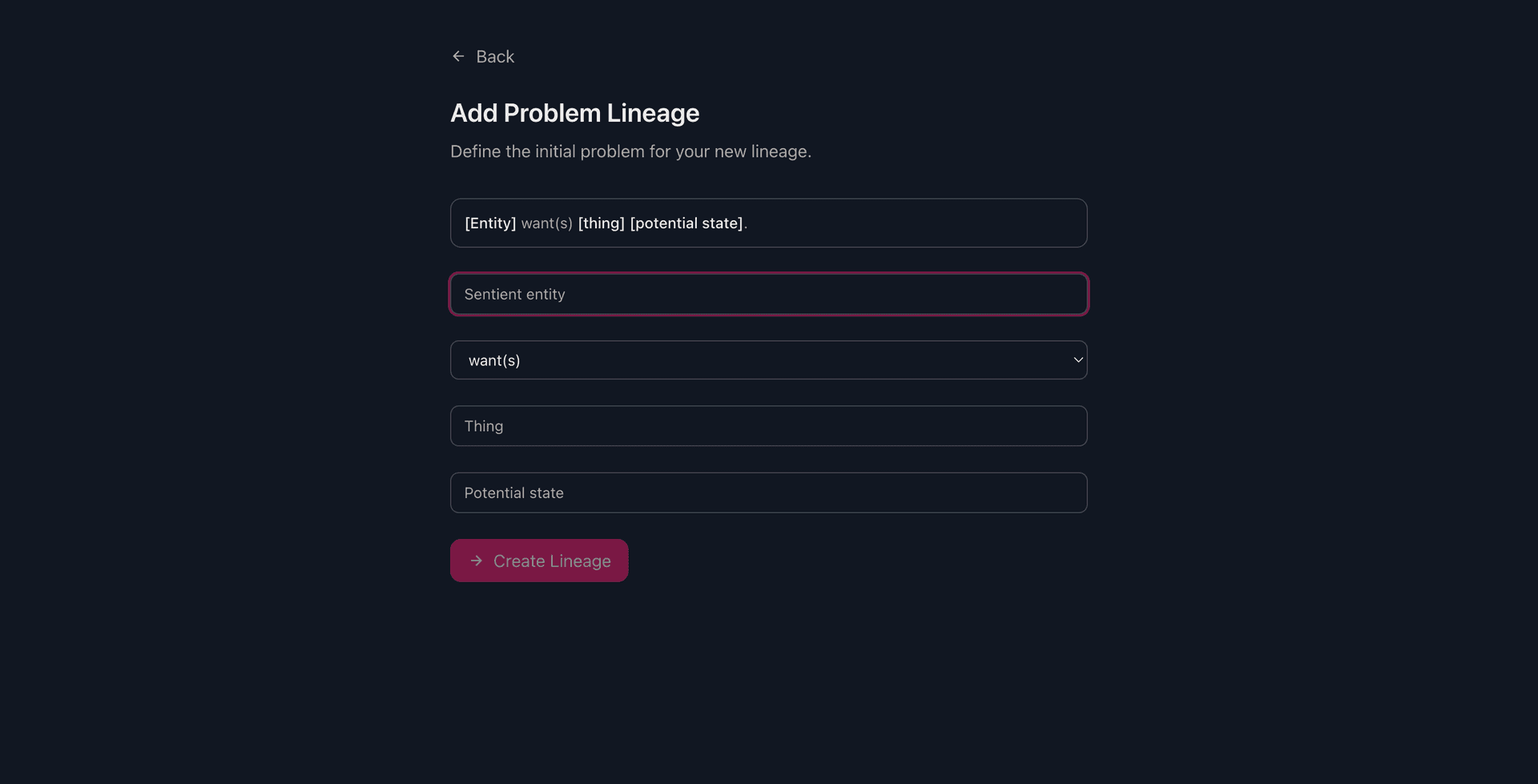
Compass captures problems using the PTT formula: [Entity] wants [thing] [state].
2Traverse the Problem Space
Navigate your problem lineage—the connected chain of problems discovered through traversal—to understand root causes and find solutions.
Up (Why?)
Find root problems and motivations. Keep going until you understand the real desire driving the request.
Down (How?)
Discover actionable solutions. Each answer becomes a potential solution that moves you closer to clearing the problem.
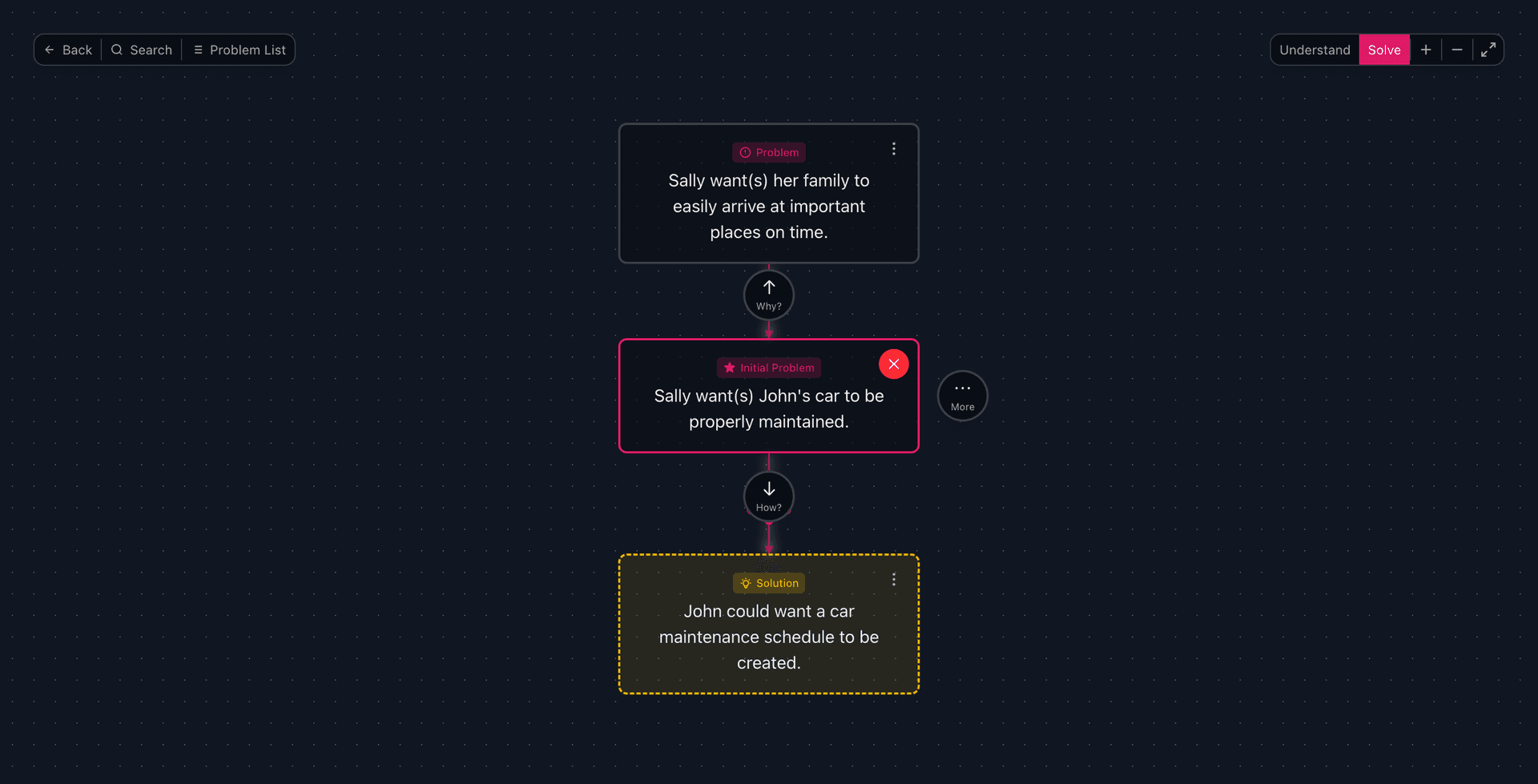
Select any problem to traverse up (Why?) or down (How?).
3Validate Desires
Before investing time or resources, confirm the desire is real and genuine. This single step prevents most wasted effort by catching misproblems—problems that seem real but stem from desires that don't actually exist.
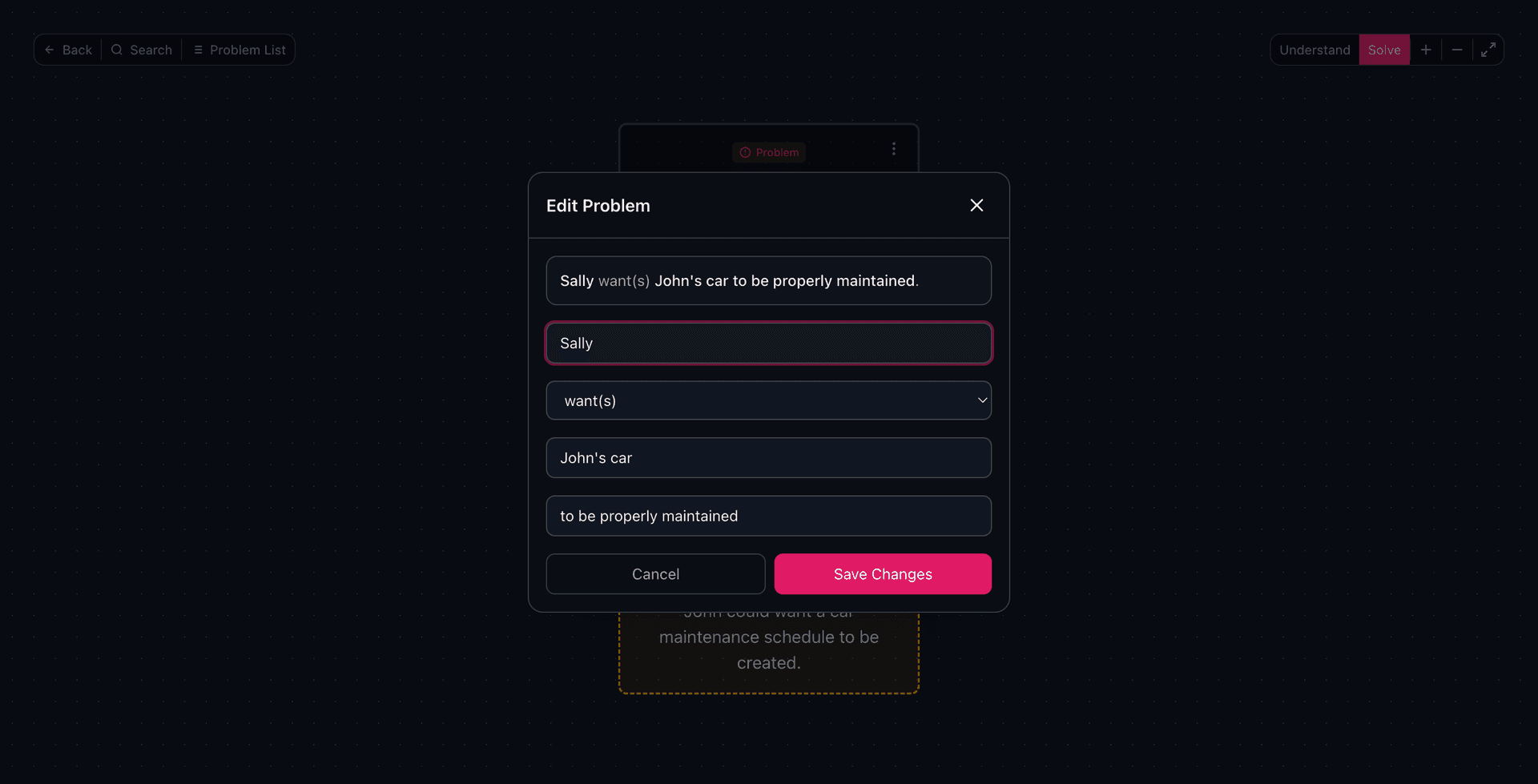
Edit any problem to refine details or change the desire type to mark it as a misproblem.
4Clear Problems
Generate real value through two paths:
- •Invalidate misproblems: Prevent waste by identifying false desires before resources are spent
- •Execute validated solutions: Build with confidence knowing genuine desire exists
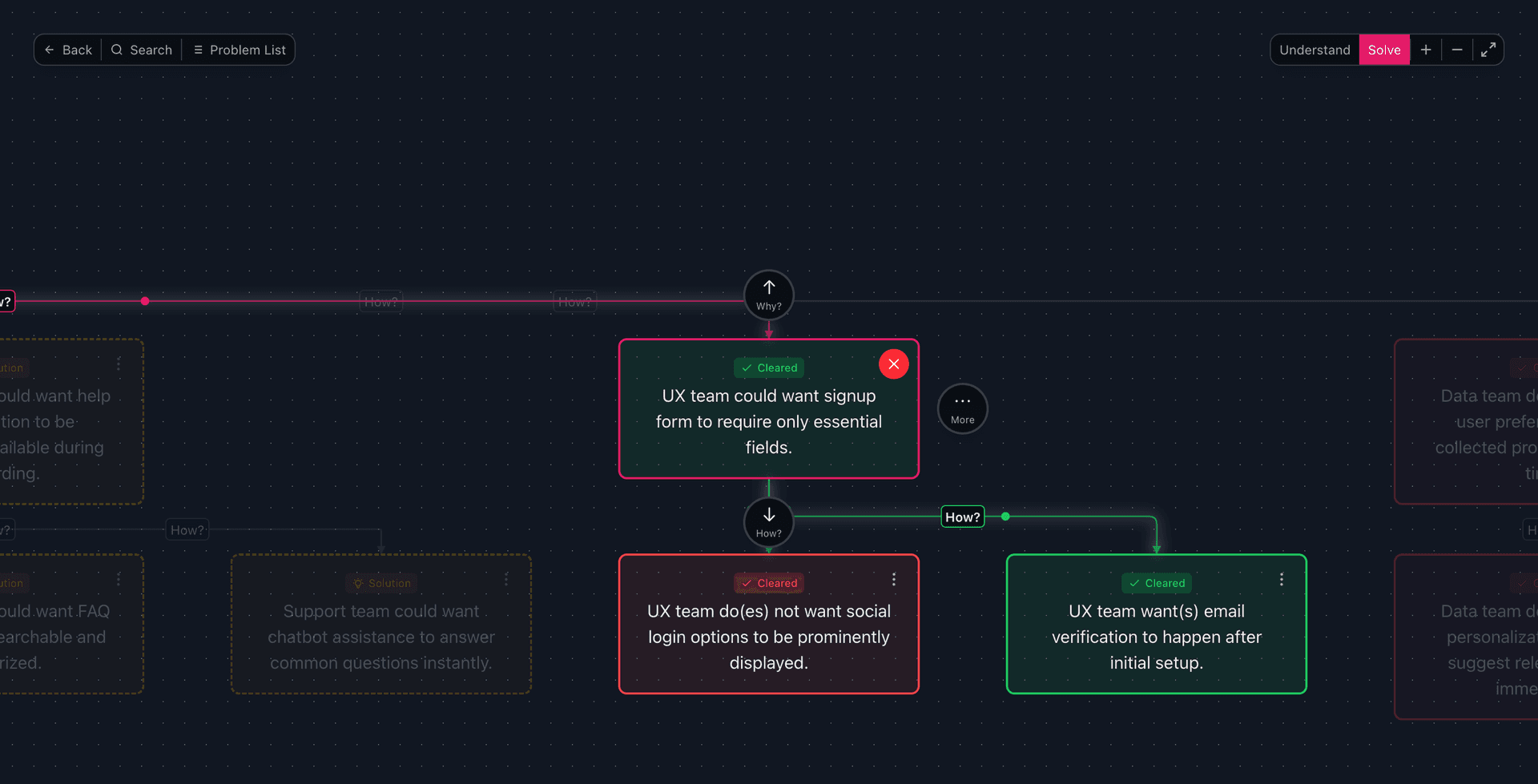
Cleared problems show your progress—whether invalidated as misproblems or successfully implemented.
5Convert Findings
Transform validated problem lineages into familiar formats—like Problem Statements or User Stories—to communicate your analysis effectively while preserving essential context.
What you'll be able to do
Identify more opportunities
Spot problems hiding in plain sight in everyday conversations and behaviors.
Deeply understand domains
Traverse up to root problems and down to actionable solutions.
Avoid wasting time
Validate desires before acting to catch misproblems early.
Generate real value
Clear validated problems with confidence knowing genuine desire exists.
Communicate effectively
Convert problem insights into clear, actionable documentation.
"Juicero raised $120 million to build a $400 juice press that squeezed proprietary packets you could squeeze by hand. Talented engineers. Beautiful hardware.A misproblem—a problem that didn't actually exist."
This failure inspired the creation of Problem Traversal Theory. PTT prevents this by validating desires before you build.
How Compass brings PTT to life
Compass is the tool that brings Problem Traversal Theory to life. Map your problem lineages, validate desires, and discover solutions you never knew existed.
What you get with Compass:
- Capture problems using the PTT formula with structured forms
- Traverse up (Why?) and down (How?) to build your problem lineage
- Mark problems as cleared or change desires to flag misproblems
- Visualize your entire lineage on an infinite canvas
- Manage multiple problem lineages across different projects
Free to start. No credit card required.